Friday, February 8, 2013

Will humans become obsolete?

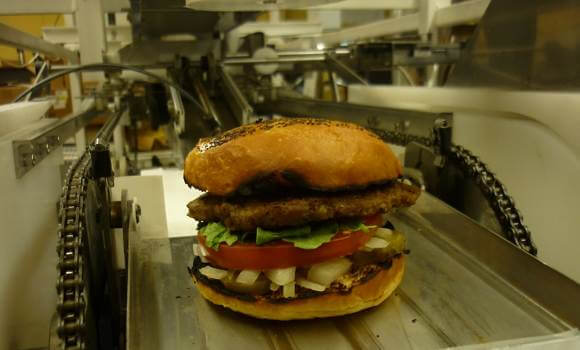
When I heard about the robot that made 360 burgers per hour, it got me wondering about technology. Will human labor become obsolete? Obsolescence overtook the blacksmith, the weaver and many other tradesmen of the past. It is overtaking the cashier, the printer, and soon the short order cook. Many of my teacher colleagues are worried about the growing online education movement, and accountants, stock brokers, managers, salespeople and other "white collar" workers would do well to watch online developments in their fields. If we extrapolate this trend into the future, it might seem as if the exponential explosion of technology will soon make all human labor (and consequently, humans themselves) obsolete. But technology doesn't eliminate labor, it only changes the kind of labor that's in demand. The question is, will we let our machines out-compete us in the labor market of the future, or will we join them.

Every new technology: printing press, steam engine, locomotive, plane, or computer, eliminates the need for some form of human labor. The mere invention of a stocking-making machine in the late 1800's put 50,000 stocking knitters out of work. And for a more extreme example, the work being done by steam engines in 1887 was equivalent to that of 1 billion men. And yet, every time, though there is an initial shock of unemployment in the affected industries, the long-term result is usually more jobs. As for the English stocking knitters, Hazlitt writes that "before the end of the nineteenth century the stocking industry was employing at least 100 men for every man it employed at the beginning of the century." And obviously the steam engine did not displace 1 billion workers. There were only a third as many alive on the Earth at the time.

There are a few reasons technology doesn't drive employment to zero. Rising population creates increasing demand, and while technology saves labor in one area, it often requires new labor in another. Steam engines require people to build them and mine the iron and coal, for example. But more importantly, labor is a natural outgrowth of human creativity and desire. If it were about meeting the basic needs of a static population, technology could, it seems to me, eliminate the need for human labor. But though human needs may be static, human desires are not, and as new technologies eliminate the need for old vocations, humans find new things to do.

Human productivity is like a tree. A new idea is a new bud, sprouting from a branch as resources and labor are brought into play, drawn up from branches, trunk, and roots below to fill a new niche in the canopy of the tree. And each new twig, at first costing labor and resources, eventually becomes part of a greater foundation, supporting further growth and exploration of the undiscovered potential of the universe. And just as the twigs and leaves multiply to fill endless new niches and expand the canopy upwards and outwards to catch the sunlight, so the ideas of humankind multiply without end. And so there can be no end to labor, because the the world of ideas is infinite.

But the nature labor changes, and this may be cause for some concern. Demand for hands, shoulders and backs decreases, and demand for computer programming and creative ideas increases. It is an evolutionary process, and it seems clear where it's headed. Automation, even artificial intelligence, supports the expansion of human activities, but what happens when computers can do every part of the process, from initial idea, to invention, development, and production, when our technology begins to compete with us in the canopy of the tree of ideas?

This coincides with the technological singularity, a concept made popular by inventor Ray Kurzweil, who believes it is coming soon. He bases his belief on the demonstrably exponential growth of technology over the last few centuries. Kurzweil predicts machines will rapidly exceed human intelligence, since they will be able to build new machines unconstrained by the limits of the organic human brain. Sci-fi? Maybe. Maybe it is simply impossible to equal the human mind. But science fiction has often become reality. It was not long ago we watched Captain Kirk open his "flip phone" to communicate with the Enterprise. And how far is it, really, from cleverbot (if you haven't played with cleverbot.com, do it now) to a "human" computer, especially considering Moore's Law?

It seems to me this event could bring about one of three things:

1) Humans are out-competed by machines, just as the lower branches of the tree die off for want of sunlight as the tree grows taller. (Perhaps the machines would keep us as nice pets, or maybe we'd just go extinct.)

2) We merge with the machines, as Kurzweil predicts.

3) We destroy the machines in a Dune-style Butlerian Jihad.

As much as I sometimes envy the simple life of my black lab, and as fun as option 3 might be, I'm leaning toward option 2, since it seems to me it's already taking place, and it's not so bad so far. Calculators have changed the way we do math, and Google may already be changing our brains.  What's the difference if the technology physically moves inside our skulls. I admit, the idea of being part computer is a bit discomfiting, but does being human require that you not try to improve yourself? I think we can augment ourselves while retaining the essence of what it means to be human. And if that's what we need to do to survive in the market of the (near) future, then we adapt or we die, just like our ancestors did when they abandoned sticks for chipped stones and stones for iron, horses for cars and pencils for calculators.

Either way, the tree of technology grows ever on and on, expanding the realm of possibility. The only question is, will we be a part of it or not. And while this may seem like sci-fi speculation, these changes could be right around the corner: 2045, according to Kurzweil. I'll be 73. And right now, every day, we are faced with similar choices regarding technology. Compete or merge. Recoil from burger-flipping robots and self-checkout isles, or figure out how to carefully assimilate them. Shun calculators, GPS, cell phones, Kindles and the internet, or use them to augment our intelligence, intentionally and effectively, until they become a part of the trunk of a thriving, more successful, effective and fulfilled life.

Sunday, January 6, 2013

A more open classroom


Photo by David Niblack
It's more open in the sense that the students have more freedom to choose assignments and modes of learning. It's open in the sense that they don't have to ask me to use the bathroom. It's open in the sense that they're free to use their cell phones. It is open in the sense that it is open-ended: What they learn is up to them. Their grades are up to them. At least, that's the idea.


I started doing it as a classroom management technique. I knew I need to change something. Last year didn't go as I would have liked. I had a hard time controlling my standard-college-prep-level sophomores. Many of them simply didn't care about atoms, cellular respiration, and DNA, and trying to "teach" them was like force-feeding medicine to a baby. No, it was worse than that, because they were not babies, but young adults, and many of them simply wouldn't (or couldn't) swallow it.


And to tell you the truth, I didn't blame them. I'm not being forced to learn anything I'm not interested in, nor do I wish to be. Nor do I remember most of what I was forced to learn in my first twelve years of schooling. I learn best when I choose what to learn and how to learn. And so do they. So that's what I'm trying to do for them--give them more freedom of choice, more ownership of their learning. And I think it's working.

For most assignments, they have four choices: one is an artistic or writing approach, one is hands-on, one is online, and one is textbook reading with worksheets. And sometimes the classroom absolutely beautiful--everyone focused, asking thoughtful questions, and working hard on different activities. For example, for our ATP lesson, I started with a brief lecture about ATP to introduce the concept, then they got to choose between four options: make a poster about ATP, make a model of ATP, make an online animation of ATP, or read a section in their text and complete a worksheet packet. The results were amazing. The online animations were fantastic, and one group made a working model that blew me away.


In general, they all work diligently on the assignments. Though there is a fair amount of socializing at times, I don't worry too much about it. My philosophy is  if they are not getting their work done, it will show in their grades, and I tell them so. And they have responded well to this responsibility.

I have taken a similar approach with my cell phone policy. If they choose to text instead of work or listen, it will show in their grades. If they are able to learn the material well, then why does it matter if they text during class? On the other hand, if they choose to neglect their work, then they should bear the consequences. I will try to persuade them to work, and I will help them overcome whatever it is that is holding them back, but I will not coerce them. That would rob them of the chance to learn to control themselves.

At times, I admit, my classroom may appear as (barely) controlled chaos, but things are not always what they seem: It is never really under my control, and I don't want it to be. I often feel as if I am riding a wave that could crash around me at any moment, but it is, I hope, a wave made of students' freedom and growing sense of responsibility.

If you would like to have a look at our Moodle site, just send me an email and I'll get you guest access.

Wednesday, October 31, 2012

On Google and thinking

Don't let Google eat your brain. Don't let the internet do your thinking for you. It's a great way to gather facts, but facts must be interpreted. This is true in all of life. A blood glucose measurement of 130 mg/dl is a meaningless fact without an interpretation (diabetes). A huge dark wall of clouds approaching from the west is a meaningless fact without an interpretation (thunderstorm). And the explosively expanding pool of facts searched by Google also need interpretation...
Read more

Monday, August 20, 2012

The beast and/in me

Sometimes it's like my intellect is a rider on a bigger part of me, a part with its own ideas about what it wants to do and not do. The rider knows I should get up, get to work, get off the internet, stop eating, choose the salad, delay gratification, be kind, plan ahead, be patient, but the bigger part of me doesn't seem to care about any of this. It wants immediate gratification. It wants to sleep in, eat junk food, procrastinate, avoid work, and to heck with the long term. It's like an animal...

Read more.

10 ways to make this year easier

High school is hard. Here are ten quick ways to make this year easier...

Read more.