Showing posts with label science. Show all posts

Wednesday, December 28, 2016

The procrastination equation: Putting research into practice at the Depot

They were discussing different forms of government, and the conversation had degenerated into a frustrating chorus of "There is no right answer. It's all just a matter of opinion."

"That's not true," I said, trying to keep the frustration out of my voice. "There are benchmarks. Some forms of government work better than others."

I'm not sure they got my point, but that kind of relativism is one of my pet peeves. Unfortunately, it infects many parts of society, including education. People in education often think that there are no real answers--no reference points by which to judge between the myriad of models and practices that promise to improve student success. But that's not true. Research has shown what works. The same science that brought us modern medicine and discovered global warming can help us educate our kids, and if we're not using it, we're fighting this battle blindfolded. Here's the story of how we're putting research into practice at the Depot, and how it's impacting our kids.

Last year was my first year at this little non-traditional school, and it soon became obvious that motivation was a serious problem. Motivation was low, engagement was low, attendance was low, task completion was low, and procrastination was high. Then I came across this article on procrastination from psychologist, Piers Steel. It was a thorough review of research related to motivation, and his "procrastination equation" became my guide. I took the liberty here to make it a bit more user friendly:


Utility is "how desirable a task or choice is for an individual." Expectancy is whether we think we will be able to complete the task, value is how much we value the outcome, the more impulsive among us will have a greater tendency to procrastinate, and the further away the deadline (the greater the delay), the more we'll put off the work.

Using the equation is simple. If utility is low, we procrastinate. To decrease procrastination, we need to increase expectancy and value and decrease impulsivity and delay. At the Depot this year, we're attacking all four factors of the equation.

Expectancy: According to Stanford psychologist Albert Bandura, "efficacy expectancy is somewhat susceptible to verbal persuasion and emotional arousal but is especially influenced by modelling and actual performance accomplishments." With this in mind, we are increasing our use of explicit instruction at the Depot, and our new Project Block is designed to provide students with a string of small successes to build upon. As of last week, about 60% of our students had completed 8 science projects, including hands-on projects, lab reports and a research paper, and had begun their first independent project.

Focused work during Project Block
The ALEKS online math system, which we also started using this year, is another way we're building self-efficacy. It offers a mastery-based approach the kids love, and our students' average progress on their courses is 54%.

And finally, we've really ramped up the 1:1 support this year. With a combination of interns and an instructional assistant, we are able to assign struggling students one-on-one help during ALEKS, Project Block, and any other time they need it.

Value: Dr. Steel points to classical conditioning as one way to increase the value factor. During our summer program, we were having trouble getting kids to do their online math work, so I was tossing around the idea of a token-based incentive system with Ellen. I had planned to make the tokens worth credits. "But what if they don't care about credits?," she asked. 

She was right. Many of our students don't seem to be motivated by threats of credit loss or offers of credit. So what did we do? We still offered credit, but we also tied the tokens to a field trip reward, and it worked. They really valued that reward!

We carried that same approach over into this year: Students earn poker chips for on-task behavior, and if they earn enough, they qualify for special field trips. Many students use our new progress tracking system to keep track of their chips and they value them so much that their anxiety about the chips has actually become a bit of a problem. My hope is that this system will build the habits of work that we adults call intrinsic motivation. According to Steel, this is exactly what happens--students associate reward with the work, and the work becomes intrinsically rewarding.

(Of course, they don't always succeed. The other day, I told a student he would not have enough chips to qualify for the field trip the next day. He pushed his few chips away on the table as if to disavow them and said, "I don't want any more chips!" His protest reminded me of my son when he was young. He wouldn't eat his Thanksgiving dinner, and the consequence was not getting any pie. "I don't like pie!," he repeated, as he marched around the table. The fact that chips can tap into their emotion is testimony that we've tapped into the value factor.)

Impulsivity:  Impulsivity is considered a personality trait, and Steel questions whether we can influence it much, but he does suggest two possibilities: stimulus control and automaticity. "Stimulus control," says Steel, "helps to direct behavior by indicating what is appropriate (i.e., rewarding) under any given circumstance," and I think the chips serve this purpose also. If students stay off their phones and on-task for 10, 15, or 20 minutes (we gradually increase the blocks of time), they receive reward chips. Most students earn the full amount of chips available during ALEKS Block and Project Block, and it's surprising to see how easily most of them can focus for 20 solid minutes under these conditions.

To increase automaticity, Steel recommends schedules and routines. This year we've implemented a new blocked schedule at the Depot, but there's more we could do with routines within the blocks themselves. Interestingly, Steel also mentions reducing choice as a means of helping those with high impulsivity. I think the blocked schedule has also helped here, especially the replacement of "self-directed learning time" with Project Block, but I'm still chewing on this one.

We've also added another research-based strategy to the mix to try to address the impulsivity factor--one that Steel didn't mention. Stephen, one of our teachers, has been teaching mindfulness during morning pick-me-up since the beginning of the year. They've gone over several techniques, from focusing on the breath to mindful eating, and they had a great time identifying thoughts and feeling invoked by popular songs the other day. Several students have said they have started to practice meditation on their own. Our hope is that this will help them not only manage stress but also increase focus.

Delay: Our new progress tracking system is designed to give students continuous, rapid feedback about their progress, and the timed chip blocks have provided small chunked goals for the students, but I think we can help students a lot more with handling delays. My goal for the second semester is to explicitly teach the students two methods of time/project management, and then reward them for each box checked off their to-do lists. (Hat tip to Elizabeth Brott Beese, a Ph.D. student from Purdue who spent some time studying our program, for pointing me in this direction.)

That is how we're using science to help our students. That's our goal, anyway, and so far it seems to be working. Engagement is up, attendance is up, and even task completion seems to be up. I was so excited to find Steel's article last year. It has provided a framework--a science-based guide for improving our program. So often in education, we bounce from one model to another, often without much confidence that any of it will work. But there's no need for that. There is a research base in psychology and education that we can use and build on. We're not blind, we don't stumble in the dark, and we don't have to reinvent the wheel. We can't afford to. Time is precious for every one of our students.

Saturday, February 13, 2016

How I lowered my cholesterol, in four easy steps


Here's how science can kick cholesterol's butt.

I'd had my cholesterol checked a few times before last year, and it was a bit high, but I wasn't really concerned. True, I'd started the high fat "paleo/primal" diet in 2012, and I'd been wondering if all that meat and fat might affect my heart, but I also knew the research was mixed (see here and here, for example). So, I ignored it and kept eating as much bacon as I could.

Then, in July 2015, my total cholesterol was up to 218, and my doctor mentioned the unmentionable: "We should probably take a look at statins," he said, "or if you want, you could try changing your diet first."

I didn't want to change my diet, which had lost me 30 pounds and had me feeling very good, but I also didn't want to take statins, with their potential muscle and liver damage.

I decided to do my own experiments.

I found Wellnessfx.com. It's a site where you can order blood tests, get your blood drawn at Quest Diagnostics, and get the results the next day online.

My plan: Get baseline data, and then every month change one variable (diet, lifestyle, etc.), and see if it changed my cholesterol.

I began last October. My baseline LDL (the bad cholesterol) was 163 mg/dL--in the "high risk" category. Since then, I've done four separate, controlled experiments on my body--one per month.

The experiments


November: Reduced saturated fats. I quit coconut milk (used in my smoothies and curries), bacon, and bacon grease (used for cooking).

December:  Supplements. I decided to start taking my old supplement regime, which included some supplements that I thought might help lower my cholesterol (Phosphatidyl choline and EPA/DHA complex). I added back the coconut milk and bacon so I could be sure I knew exactly which change had the effect.

January: Wine. I quit the supplements, kept the fats, and increased my wine intake to every day instead of just the weekends. I know, it was tough, but my health was worth it. :-) But seriously, red wine has been shown to have a beneficial effect on LDL and HDL (see here and here).

February: Exercise. Cut back to weekends-only with the wine, keep the fats, and add more exercise. For this, I started doing CrossFit at CrossFit Storrs three times a week for a month (in addition to my normal, much milder workout regime).

The results


The graphs speak for themselves.

(Data is beautiful, and science is so awesome!)

Reducing saturated fat  lowered my LDL.

Supplements had no beneficial effect.


And wine... wow! This is your HDL on wine:

After a month of a couple of glasses of home made Cabernet per night (with beer on my Saturday cheat days), my HDL went from 51 mg/dL to a whopping 60, and LDL went down as well!

And then there was CrossFit... Boom! After a month of CrossFit, my LDL was a full 24 mg lower than baseline--almost out of the red zone, and HDL was up again.

But to see the real power of these last two experiments, let's take a look at the total to HDL ratio. Because HDL counteracts LDL, this ratio may be the best way to assess risk, and the CrossFit drove the ratio down to 3.4, a full unit below the highest it had been.

This month, I didn't want to stop CrossFit, but I'm doubling down on the saturated fat reduction--cutting out coconut and bacon again and reducing red meat and eggs.

Finally, next month I'll put it all together: reduced fats, increased wine, and CrossFit. I'm hoping to push that LDL into the orange zone, that ratio right through the floor of that graph, and those statins right out of the realm of possibilities!

It's been so much fun doing science again, especially on my own body! It's a great example of the power of the scientific method for solving real problems.

Avoiding statins is huge, but discovering CrossFit has been a major added bonus! The people are awesome, the workouts kick my butt, I feel great, I'm learning all sorts of new skills, and I'm getting stronger.

Meanwhile, keep calm and science on!

PS: Obviously this is not a replicated study, so all these effects could be random. It would be great to replicate this, but that would take a long time. What the heck. Maybe I'll do it. But I'm also hoping that by adding all the beneficial factors together at the end, I can increase confidence in the effects.

Sunday, November 29, 2015

Science, math, and choice at the Depot

I was more excited than I look. :-)
This blood-typing experiment was a great way to kick off the week! The meticulous way this student handled the samples was beautiful to watch. But the best thing about it was that she chose this experiment, sort of.

The Big Picture model doesn't rely on a traditional curriculum. Theoretically, student interest drives instruction, but it's not quite that simple.


Here at the Depot, students work through some predetermined activities: an autobiography, written reflections, oral presentations, online math programs, and reading and math groups, but much of their time is taken up by activities of their choosing. They spend two days a week at an internship and they get at least an hour a day for self-directed learning, which often involves projects they design, aimed at learning goals of their choice.

The blood typing experiment was one example, designed to meet a science requirement. Another student gave an energetic "pick-me-up" presentation this week to the whole school on the "Law of Attraction" and how positivity can benefit your life. She told her peers that negativity only attracts negative people and events to your life. She testified about the benefits she had seen: weight loss, more friends, less depression. Her peers were fully engaged, carefully filling out "gratitude lists" for the activity at the end. It was an exciting example of an interest-based project.

But this system is not without its challenges. What do you do, for example, with those students who are not motivated to do any independent work? And what content or skills should be mandatory, if any?

From what I've seen so far, most students prefer to demonstrate skills like collaboration, creativity and communication, rather than academic content knowledge, critical thinking, empirical or quantitative skills. The blood type experiment, for example, was not fully the student's choice. It was done to fill a science requirement, though the student chose how she would fill it.

Why is it that most students don't naturally want to do scientific experiments or academically rigorous projects on their own time? Why do we have to force it with requirements? Is it because their previous schooling has turned them off to academics or because they lack the skills, or both?


While I may choose to pursue a scientific research on my own time (I love Google Scholar), I'm also pretty good at it, and I've had lots of positive experiences with it, so I enjoy it. I could be wrong, but I think that's the key. 

The first student would not have chosen a blood type experiment without a science requirement, even though she was interested in blood, but the second student gave talk on positivity just because she wanted to. The difference? Maybe a bit more interest on the part of the second student, but a big difference in confidence and competence. The second student felt much more competent with both the content and the skill of presenting that talk. Even though the first had more skill than she recognized--she's a natural in the laboratory--she was probably a bit intimidated by the scientific content.

If our students lack competence (or confidence) in math and science, they will not choose to study it. I've heard many students, here and elsewhere, say how they once loved science--until middle school or high school, when they started to feel they lacked essential skills to pursue it. As Dr. Ross Greene puts it, "Kids do well if they can. The real question then, is "How can we help them gain the competencies they need so they'll start choosing to pursue greater competency math and science?"


Which leads me to the question of how to increase their competence. As I read more of Hattie, and as I experience more at the Depot, I'm starting to feel a need for some blend of explicit instruction with student autonomy. Maybe they can be persuaded to pursue greater competence in these areas if adequate support is provided, or maybe there is a need for a structure that mandates science and math skills and really teaches them well to all students.

There is no doubt that options are powerful and interest is a great motivator, but without essential science and math skills, science and math really aren't even an option at all, and that's not acceptable. The world today is too technical for that. But with the right supports in place, I think they'll all jump at opportunities to do science and math.

Tuesday, April 7, 2015

Genes are just apps our cells run

Been thinking through ways to make DNA and genetics understandable to my high school biology students.

Simple is important, and oversimplification is often necessary.

Thursday, we move into genetic engineering and the pros and cons of genetically modified organisms (GMOs), a controversial topic these days, with all the calls for labelling GMO foods, protesting against Monsanto, etc.

And I've been listening to Made To Stick, by Chip and Dan Heath, and their S.U.C.C.E.S.S. check-list for making ideas stick--make them:

Simple
Unexpected
Concrete
Credible
Emotional
Stories

With technical concepts like the way that "information" in DNA is used to make proteins in your cells which then are used for all sorts of things in your body, and eventually create traits like eye color and who knows what else. It's hard to make a SUCCESSful message.

I wasn't able to hit all 6 criteria on the Heath brother's check-list, but here's what I came up with:

Genes are the apps our cells run.

I like it, but will they? We'll see.

It has lots of cool extensions: genetic engineering--making Glo Fish with jellyfish genes or making corn that can survive Round-Up herbicide--is just like downloading a new app into the cells of teh the fish or plants.

And just imagine what sorts of "apps" we might download into our own cells in the future?

Thursday, March 5, 2015

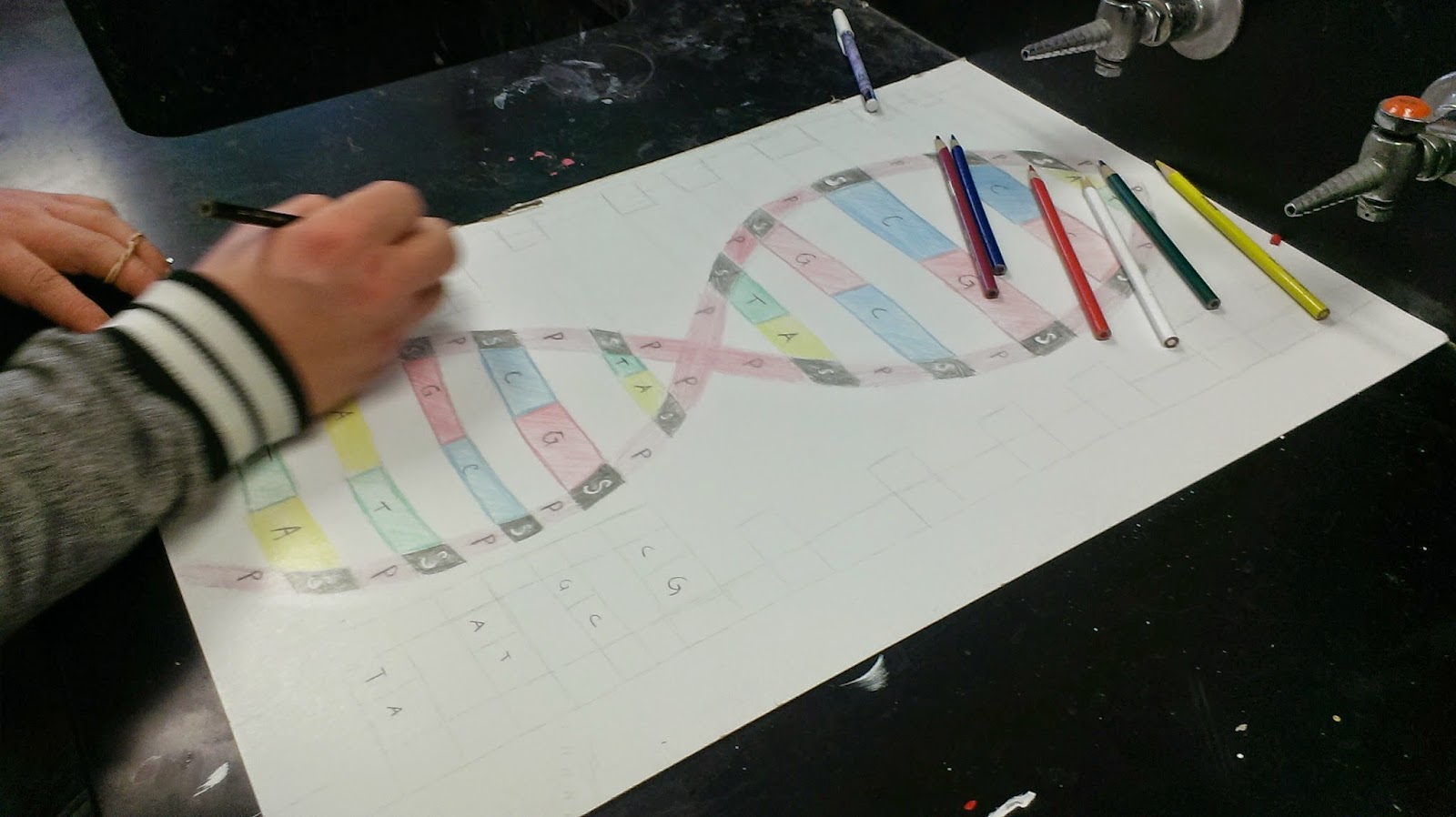
Students interpreting the beauty of DNA

Bio class, you were on fire today! Thank you for the cool work you're doing! I felt like an art teacher and a science teacher at the same time, watching you interpret the the beauty of DNA.


Friday, February 13, 2015

So that's how it is

http://digital.films.com/play/UZSWS6
"Do you know what I like about our kind of work? You can be happy or unhappy; it makes no difference. It doesn't matter if you like what you find or hate it. You look at it and say, 'So that's how it is!'" -Rosalind Franklin in Double Helix

Watching the BBC's classic story of the discovery of the structure of DNA, today with my biology students, two things stood out.

1) They looked bored. I like to show the film because it depicts science as it's really practiced, with all the political and interpersonal realities. I love the brilliant contrast of Watson's focus on the goal of discovery (and the fame) and Franklin's zen-like devotion to the process of discovery itself. And I want to light that same fire in my students. But maybe there's a better way than this film. I recall a tweet from a teacher friend on Twitter: "If they are bored, STOP."

2) Rosalind Franklin, played by Juliet Stevenson, backs this up. For all my good intentions and all the movie's merits, if it is not the best way to light kids fires for science and siscovery, then it's not the best way. Instead of defending my past practices and habits, I need to look at the data, with Franklin, and say, "So that's how it is." Then adjust my strategies accordingly.

And this may mean I've made a mistake. It may mean I've been doing it wrong. So be it. This is just one movie, but the same principle applies to all my teaching, even the new mastery-based teaching methods I'm piloting now. (It may apply to my whole life.) But when I'm worng, I need to take Rosalind's perspective. I love what she said at the end of the movie when veiwing Watson and Crick's model of DNA, which they deduced from the meticulous data she produced: 
"It doesn't matter. THIS (DNA model) is what matters. Life is the shape it is for a purpose. When you see how things really are, all of the hurt and waste fall away. What is left is the beauty."  
And neither does it matter if I end up having been wrong. What matters is what's true. I want to see things as they really are, regardless of the implications for my pride or lifestyle.

As Sagan said, "It is far better to grasp the universe as it really is than to persist in delusion, however satisfying and reassuring."

Tuesday, January 6, 2015

A call for a more scientific approach to education

Sometimes my head swims and my heart sinks when I see so many different perspectives on education. Everyone seems to have their own agenda, some promoting grit, and other opposing it, some promoting increased use of data and assessment, and others want less of it, some excited about differentiation and deleveling, and others attacking it, some excited about standards, others hating them, some voices calling for change, others asking what's wrong with the status quo. It makes you wonder sometimes if agreement is even possible, if the complexity can ever be overcome, or if real answers even exist.

But then I remember... of course there are answers. The world is complex, and humans, especially, but every time people say that humanity can't solve a problem, humanity proves them wrong. Every time people say science can't possibly figure it out, it does.

Patience. That's what's needed, and one clear goal upon which we should all be able to agree: improvement of our situation, and a meticulous, dogged, scientific, unrelenting pursuit of that goal. That's what it will take to clear away the confusion of the conflicting voices. As Neil deGrasse Tyson said:
"Any time scientists disagree, it's because we have insufficient data. Then we can agree on what kind of data to get; we get the data; and the data solves the problem. Either I'm right, or you're right, or we're both wrong. And we move on. That kind of conflict resolution does not exist in politics or religion."
Or in education... yet.

Friday, November 21, 2014

Math, music, and life


This stunning visual/auditory bombshell by Nigel John Stanford combines art, science, and electronic music in way I've never seen, and the quote midway through may not be convincing, but it is thought provoking:
"Everything owes its existence solely and completely to sound."

-Peter Guy Manners
I'm not inclined to believe it's all about sound, but I do wonder about waves, or more precisely, equations. Chladni plates have always been one of my favorite links between the world of mathematics and the physical world of the senses, and my absolute favorite demonstration to get students thinking about the connection. Students see the patterns of sand change abruptly as I increase the frequency, and I tell them that atoms and electrons are like this, and that it can all be described by equations.

I think it was Hawking who referred to the universe as a "dance of geometry," and I am inclined to believe that. But is everything really reducible to equations?  Isn't that a low view of life and love and being human?

Is it? I was listening to Protoculture's hard-hitting new track, Music is More Than Mathematics yesterday, and had this thought: Maybe the problem is that we have too low a view of math. Maybe we have too low a view of equations. We see them as hard and cold, inflexible and limited. But maybe we don't see how they can be or could become so much richer than we imagine, that they could contain all of the richness of life and the universe.

What if the richness of music, which after all is just sound waves, were our hint that it really is all about math, but that math is much more than what we think--much more than numbers and letters and symbols and drills and tables and lists? What if math is all about order and beauty and wonder and power and change and vibrancy and life and potential?

And as science and math progress, and our paradigms and pictures of the world shift again and again, and the richness of the picture deepens, and the equations shift from Ptolemy's to Newton's to Einstein's and Schrodinger's and Dirac's, the symphony of nature and life is not silenced, not even just magnified or amplified or clarified, but renewed, transformed, and reborn, every time.