Showing posts with label grit. Show all posts

Friday, March 8, 2019

Has coddling destroyed a generation?


One of the most common conversations among educators these days is the rising tide of anxiety and depression among young people. This disturbing trend comes at a time when schools are already being asked to do more and more academically, and these two factors are creating a perfect storm that we are having difficulty navigating. And so we are seeing ideas like grit, resilience, social-emotional learning, and trauma-sensitivity being offered up as possible solutions, and this new book by Greg Lukianoff and Jonathan Haidt, The Coddling of the American Mind.

The basic premise of the book is that by protecting our children and students from everything from peanuts to opposing viewpoints, we have crippled our college campuses and created a mental health crisis among teens and young adults. The book is definitely worth a read. The increasing prevalence of anxiety and depression among young people is something I deal with every day, and it's clear that something has gone wrong on college campuses when speakers are being "disinvited" simply for holding opposing political viewpoints.

I also see overparenting as a major issue. It's a constant struggle as a parent to keep from overprotecting your kids from failures and consequences, and the same goes for running a school. What is needed is an authoritative approach, with clear rules and consequences and a focus on support, rather than a permissive or authoritarian approach. Coddling is a good reminder that we do damage by not allowing our kids to experience difficulty. I always viewed parenting as repeatedly casting my kids out and reeling them back in. 

But while I think the book makes important contributions to the discussion, I also think it muddies the waters a bit. The authors are huge fans of Cognitive Behavioral Therapy (CBT), and they noticed that some of the cognitive errors targeted by CBT are similar to logical errors being made, in their opinions, by parents, schools, students and universities that are overprotecting kids. From there, they built their case that overzealous censorship at universities and the mental health crisis were symptoms of the same cause--what they call the "3 Great Untruths."

1. What doesn't kill me makes me weaker
2. Always trust your feelings
3. Us vs. them

While I agree that these are dangerous errors, I think this greatly oversimplifies the problem. From my perspective as an administrator, overzealous protectionism at schools has little to do with ideology or philosophy and everything to to with protecting ourselves from litigation. But that is a minor issue compared to the question of what is causing the mental health crisis.

The authors themselves mention some other possible causes of rising anxiety and depression, such as screen time (citing Jean Twenge's book, iGen). Sarah Rose Cavanagh has questioned the role of screen time, but suggested several other possible causes, including the decline of "face-to-face social communities" and economic inequality, just to name a few.

Human psychology is complex, and the changes taking place in our society are profound. Take, for example, the massive cultural shift that has been under way in our whole worldview as a society. I just finished listening to The Denial of Death by Ernest Becker. This classic lays out Becker's theory of what happens when you strip the dominant religious worldview from a culture. Who knows but that we are also seeing those types of effects today among young people?

We live in a world that has become a whitewater rapid of change--technologically, culturally, economically, you name it. Anyone growing up in such a world as this would be understandably prone to anxiety, just as much as they would if they were born in the midst of a river rafting trip.

I think our best bet in supporting them is to do just that--support them with research based practices and provide high expectations backed up by high levels of relational and academic supports. Allowing them to experience consequences is part of this, but my concern with this book is that is reflects a movement to discount the massive changes taking place today and their impact on kids. Kids today have to be tougher, in my opinion, than I had to be growing up. It means we have to be there for them even more than ever, casting them out into the whitewater and reeling them back in again, again and again.

Tuesday, February 26, 2019

Why grit is situational and what we should really be focusing on

Picture this: An Agricultural Education student can't get his mower started. He's been taught a troubleshooting procedure, but instead of going through it on his own, he gets off the mower, walks over to the teacher, and asks for help.

The other day, some colleagues and I were talking about the concept of "grit," and this student was one of our examples of a lack of grit.

We extended our discussion to other classes, and one teacher brought up an example of another student who did the same thing in biology class--asking for an answer before even trying to find the answer on his own.

But then another Agriculture teacher in our group spoke up, "I know that student you are talking about, and in my Ag class, that student never asks for help. He troubleshoots the tractors on his own all the time."

In Ag, he shows grit, but in biology class, this student gives up before he even tries. And so it occurred to us: Grit is situational. A student who shows grit in one class may not show it in another class. When he or she feels confident, he or she shows grit. When he or she lacks the skills or experience, he or she does not show grit. Could it be that simple? Could the grit concept be that wrong?

We certainly aren't the first to question the concept. In a recent peer-reviewed article, What shall we do about grit? A critical review of what we know and what we don't know, Marcus Crede writes that there are several major problems with the grit concept:

  1. Grit is supposed to be a combination of perseverance and passion, but evidence suggests it's is just another word for contentiousness, one of the well studied "Big 5" personality traits.
  2. Grit is supposed to be strongly correlated with student performance and success, but there are actually other factors that show much better correlation, such as test scores and cognitive ability. In fact, if you control for conscientiousness, grit shows almost no effect. 
  3. Interventions to improve grit are questionable, since efforts to improve conscientiousness have only small effects.
So where does that leave us? Maybe it leaves us with plain old quality instruction in skills that build competence and confidence. Competence and confidence that will manifest as grit.

Friday, June 15, 2018

The obstacle becomes the path: A short commencement speech

There is an old Zen story about a king whose people had grown soft. He wanted to teach them a lesson, so he put a big rock in the middle of the main path to town, blocking the road. Then he hid in the woods to watch what they did.

One by one they came. Most just complained. Some would try a little to move it, then give up.

Finally, one lone peasant came along. He pushed and pushed at the rock. Tried to get his hands under it and lift. Nothing worked. Then he had an idea. He went into the woods and got a large branch and used it as a lever to move the rock.

Under the rock the king had hid a purse of gold and a note that said: “The obstacle in the path becomes the path. Never forget, within every obstacle is an opportunity to improve our condition.”*

You have all had your share of obstacles in your paths. But you didn’t give up. You found new levers.

And you found new strength.

Don’t forget that.

Don’t forget that there are always other levers, and there will always be new strength.

High school will not be your last obstacle. I can guarantee that.

So remember this lesson. Remember what happened when you didn’t give up.

Remember how the obstacle became your path.

And don’t give up.

I hope that you have also learned a few things about effort--that it’s not easy to move those stones, even with a lever.

But effort pays off with new opportunities.

Now that you’ve graduated, you automatically have multiplied your opportunities.

You can repeat that process of multiplication. Every obstacle you overcome, every challenge you take on will be a multiplier.

Jobs, college, new degrees, new learning, will all multiply your options.

That’s the point. It’s not about gold purses. I think the purse of gold coins was a little lame, actually.

Here’s my version: The guy works and works on the stone until he gets so strong he can move it. He becomes like Hercules. And then he walks to the city and gets a job as the king’s own bodyguard. Or something like that.

Or maybe this version: She moves the stone and finds that the path beyond is not just one path, but a whole bunch of paths to places she hadn’t even dreamed of.

The point is, the obstacle doesn’t become a prize. It becomes a path. A new path.

And here’s the other problem with the story. You’re not alone. You don’t need to move the stone alone. Reach out for help. That guy or girl should have gone and gotten some help with that lever. The story would be just as cool and so would you. Asking for help is not a sign of weakness. It takes guts to ask for help, just like it takes guts to keep pushing at those stones that don’t seem to budge and to go looking for levers.

See, that’s the other benefit to obstacles. They draw us together with other people, and that’s what’s really important in life.

So congratulations Depot Graduates! You moved this stone! And I am excited to see what you find beyond it!

And good luck as you continue on your paths and convert more obstacles into new paths to success.


*Thanks to Ryan Holiday for the Zen story and for his excellent book, The Obstacle Is the Way.

Friday, January 23, 2015

Gattaca and the growth mindset

Nature vs. nurture.

Genetics vs. environment.


It's an age old (and tiresome) debate, recently re-framed by Carol Dweck: Fixed vs. growth mindset and, and depicted in a beautiful film called Gattaca.


I don't show a lot of movies in my classes--there aren't a lot of full length movies our there that are worth the class time, but I show Gattaca every time I teach biology.

It's not so much because of the questions it raises about genome sequencing (though those are interesting, timely and relevant questions). I show it mainly because I think it has an awesome and powerful message about living life.

For those of you who haven't seen it, Ethan Hawke plays a "God child"--a person conceived naturally, struggling to live in a world of people engineered for genetic perfection. His world believes that genes are destiny, but he sets out to prove them wrong--that genes are only part of the story, and that the limitations they place on us can be overcome.

And isn't this part of what makes us human? Overcoming limitations, pushing back boundaries?

That's why we watch it. And after we watch it, I ask my students to answer the question: Do our genes determine our destiny? It's a question that gets to the heart of education and growth in general. It's a message about growth mindsets and grit. It's a message I want my students to get loud and clear. I'm not sure there are any lessons more important: "There's no gene for the human spirit "

When Irene (played by Uma Thurman) finds out Vincent, through hard work and perseverance and has bypassed the discriminatory system and become an astronaut despite his flawed genetics, she says: "It's not possible."

Vincent replies, "You are the authority on what is not possible, aren't you Irene? They've got you looking for any flaw, that after a while that's all you see. For what it's worth, I'm here to tell you that it is possible. It is possible."

What's possible for you? For me? For our students?

What's holding us back, but our mindsets?

Friday, December 19, 2014

The education flywheel


"Right now, the flywheel is at a standstill. To get it moving, you make a tremendous effort. You push with all your might, and finally you get the flywheel to inch forward... You keep pushing, and the flywheel begins to move a bit faster. It takes a lot of work, but at last the flywheel makes a second rotation... It makes three turns, four turns, five, six. With each turn, it moves faster, and then—at some point, you can’'t say exactly when—you break through." -Jim Collins

I love the flywheel concept from Good to Great: Breakthroughs seem to happen overnight, but they're really the result of a slow build-up of momentum.

The chick breaks out of the egg all of a sudden, but only after weeks of development. Big changes take that kind of patient, consistent, undaunted work.

That's been my goal these last several days: Through failures and setbacks and obstacles and opposition and hurdles and negativity and pessimism and fear and resistance from within and without, to keep pushing ahead.

But I've been seeing what Collins meant about the importance of faith.

I believe we will breakthrough, and every student will succeed.

Thursday, December 11, 2014

The power of a teenager

For years I have been telling my students about their potential--that they are selling themselves short, that they can accomplish so much more than we adults give them credit for--than they give themselves credit for. I tell them stories about Ben Franklin, Oprah Winfrey, and Richard Branson, examples of teens who didn't wait until they were "grown up" to get started on their dreams.

I want to tell you about one of my former students who embodies that ideal. She was in my biology class two years ago. She did well, but her heart was elsewhere. Her passion was fashion, and she had tremendous independence and initiative. She decided to withdraw from her brick-and-mortar high school and enrol in an online high school so she would have more flexibility. She literally began working the New York City fashion scene at 16, modelling, styling, blogging and reporting.

I had run across her posts and blogs on Twitter, and was amazed at the maturity, creativity, and insight she showed. She's not only a great writer, but she has such a unique personality and voice that it's no wonder she's been published on Parade, Lucky, Rachael Ray, and HuffPo Teen. Her awesome fashion blog website is a model of style, authenticity, and electric energy.

It takes real discipline, courage and grit to successfully leap from traditional schooling to an independent online education. No teachers constantly reminding you of what must be done, telling you what notes to take, and spoon-feeding you information.  You're on your own. It takes real independence and self-discipline to pull off online education. (That's why it sometimes gets a bad rap.) She has not only done it, but done it well, and all while building a real career, one many adults would envy, while in her teens.

I don't tell my students that they have tremendous potential despite their age. I tell them they have tremendous potential, especially because of their age. Creativity and energy are at their peak before age 30. It's exciting to see a young person taking her abilities seriously, taking real risks, doing real things, in the real world, with such charisma, originality, and power.

I had a blog once called Escape Adolescence. It was devoted to helping teens see their real potential. Alexa didn't need me to tell her. She had a clear vision, a clear passion, and the grit and courage to make it happen. I wish her all the best, but I don't think she needs my wishes.


Tuesday, November 18, 2014

Change and Moodle at E. O.


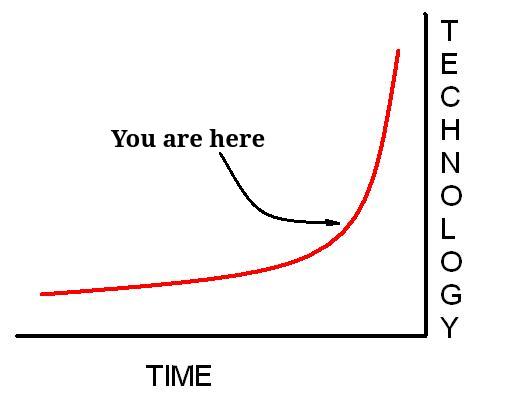
Moodle. It evokes diverse reactions among the staff at E. O. Smith High School. As a learning management system and online educational platform, you can't beat it, for the price (it's open source and "free"). It's not the most user friendly system, and if all you want to do is post a few links or homework assignments online, it's sort of like buying a car factory when all you need is an occasional ride. But the adoption of Moodle at E. O. Smith is good practice for what's in store for all of us as we move up the exponential curve of change that is the 21st century.


A little history: In 2012, Jon Swanson and I received a grant from the E. O. Smith Foundation to run two online science enrichment courses over the summer. We set them up using the Moodle learning management system hosted at crteacher.com. The next year, we both began using Moodle to help us "flip" our biology and chemistry classes. Promising results led E. O. Smith to adopt the Moodle platform for their official teacher webpages.

Today, most of our teachers are using E. O. Smith's Moodle site at least as an online point of reference for their classes, and a bunch of us are using it as an integral part of our courses. 14 teachers have had over 1,000 views or posts in the past month, and 5 courses have received over 3,800 posts/views over the same period. School-wide, our site had almost 150,000 views and posts during the month of October.

While I think this represents a serious accomplishment for E. O. Smith, and while I think the Moodle platform is essential for the kind of flipping I do in chemistry, and while I LOVE the open source model and ethic that Moodle embodies, I am under no illusions that it is the end of the story.

For one thing, Moodle pales in comparison to Google Drive for file sharing and collaboration. And more importantly, It will probably pale in comparison with the next innovation that may be right around the corner. That's the exponential nature of our era.

What will that new thing be? Google Classroom? Quite possibly.

Something we haven't even seen. Just as possible.

One thing's for sure. Moodle, and all of us, must adapt to survive.

One thing's for sure. Change is the only constant.

But let's just remember, it's not about change for the sake of change (as exciting and interesting) as that is for change-addicts like me. It's about continuous improvement. Online tech is useful only inasmuch as it is a facilitator of learning.

But its potential in that regard is amazing. So much so that its impact is likely to be exponential.